
Zaratornis stresemanni,
White-cheeked Cotinga
Assessment by:
BirdLife International

View on www.iucnredlist.org
This PDF was generated on 9 March 2026 and accurately reflects the assessment page on the Red List website as it appeared on the date of generation.
The canonical reference for assessment data is the assessment page, not this PDF. For the most up-to-date version of this PDF, please visit
https://www.iucnredlist.org/species/22700773/222728108.
Taxonomy
| Kingdom | Phylum | Class | Order | Family |
| Animalia |
Chordata |
Aves |
Passeriformes |
Cotingidae |
Scientific Name: Zaratornis stresemanni Koepcke, 1964
Synonym(s):
• Ampelion stresemanni stresemanni Collar and Andrew (1988)
• Ampelion stresemanni stresemanni Stotz et al. (1996)
Common Name(s):
| • English: |
White-cheeked Cotinga |
Taxonomic Source(s):
del Hoyo, J., Collar, N.J., Christie, D.A., Elliott, A., Fishpool, L.D.C., Boesman, P. and Kirwan, G.M. 2016. HBW and BirdLife International Illustrated Checklist of the Birds of the World. Volume 2: Passerines. Lynx Edicions and BirdLife International, Barcelona, Spain and Cambridge, UK.
Identification Information:
18 cm. Distinctively patterned cotinga. Black crown. Silvery-white face and cheeks. Grey-brown throat and upper breast. Rest of underparts yellowish-buff, coarsely streaked black, except in mid-belly. Brighter crissum. Upperparts striped buff and dusky. Dusky wings and tail fringed yellowish. Red iris. Juvenile paler, with drab breast. Similar spp. Juvenile Red-crested Cotinga Ampelion rubrocristatus has grey crown, lacks white face and has less well-defined plumage. Voice Frog-like song is loud, low-pitched and nasal reh-reh-reh-rrrrr-rE-rE, lasting c.4 seconds.
Assessment Information
| Red List Category & Criteria: |
Near Threatened
C2a(i)
ver 3.1
|
| Year Published: |
2023 |
| Date Assessed: |
March 02 2023 |
Justification:
This species has a small population, which is in decline due to the loss and degradation of Polylepis woodlands within its range. It is therefore assessed as Near Threatened.
Previously Published Red List Assessments
2016 – Vulnerable (VU)
2012 – Vulnerable (VU)
2008 – Vulnerable (VU)
2006 – Vulnerable (VU)
2004 – Vulnerable (VU)
2000 – Vulnerable (VU)
1996 – Vulnerable (VU)
1994 – Vulnerable (VU)
1988 – Threatened (T)
Geographic Range
Range Description:
Zaratornis stresemanni is patchily distributed in the Cordillera Occidental of the Andes in Peru (La Libertad, Ancash, Lima, Ayacucho and Arequipa), with most records on the west slope.
Country Occurrence:
Native, Extant (resident): Peru
Distribution Map
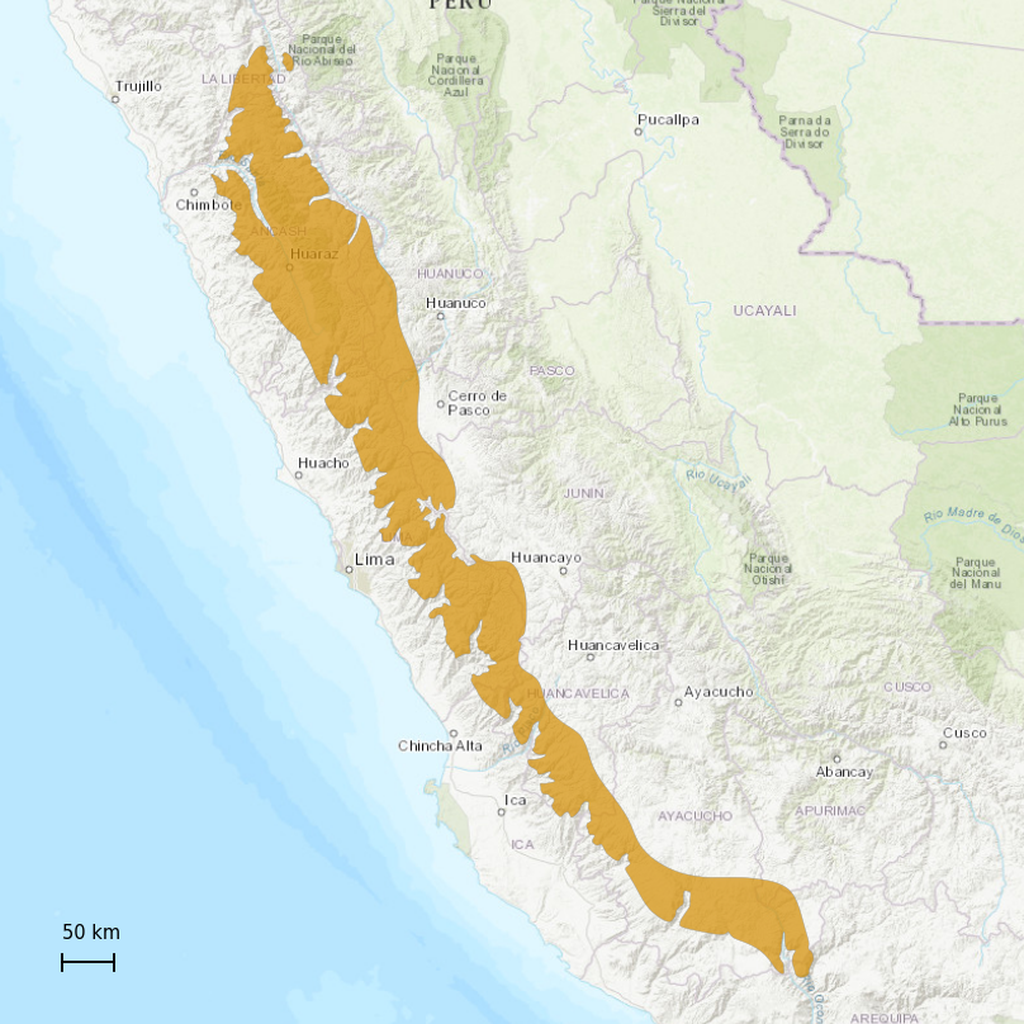
Tiles (C) Esri -- Esri, DeLorme, NAVTEQ, TomTom, Intermap, iPC, USGS, FAO, NPS, NRCAN, GeoBase, Kadaster NL, Ordnance Survey, Esri Japan, METI, Esri China (Hong Kong), and the GIS User Community
Compiled by: BirdLife International and Handbook of the Birds of the World 2022
Legend
 EXTANT (RESIDENT)
The boundaries and names shown and the designations used on this map do not imply any official endorsement, acceptance or opinion by IUCN.
Population
The species is patchily distributed, but locally common or fairly common. In 1992, the population was suspected to number 1,000-4,000 mature individuals (Collar et al. 1992), though this may be a slight underestimate. Tentatively, the population is here placed in the band 2,500-9,999 mature individuals, but an accurate quantification of the population size is urgently required.
Trend Justification
The species is suffering from the loss and degradation of Polylepis forests within its range, on which it strictly depends, while heavy grazing by livestock does not allow the forests to regenerate. Consequently, the population is inferred to undergo a slow decline, the rate of which has not been quantified.
Current Population Trend: Decreasing
Habitat and Ecology
(see Appendix for additional information)
The species inhabits small patches of Polylepis woodland with a ground cover of Gynoxys shrubs and puna grass, mostly at elevations of 3,250-4,760 m (Schulenberg 2020). Despite being resident, it may undertake some seasonal altitudinal movements and descend to lower elevations during the dry season between August and November. It feeds primarily on two genera of mistletoe, for which it is the main seed-dispersal agent (Castañeda Gil 2010). Nest-building has been recorded in March, and nests with eggs and young have been found in May.
Systems: Terrestrial
Threats
(see Appendix for additional information)
The most severe threat to the species are uncontrolled cutting of Polylepis woodlands for timber, firewood and charcoal, and heavy grazing by livestock, which prevent forest regeneration (Fjeldså and Kessler 1996; J. Fjeldså in litt. 1999, 2007; SERFOR 2018). Other factors include the inadequacy of afforestation projects, in particular the use of exotic plants (Fjeldså and Kessler 1996).
Conservation Actions
(see Appendix for additional information)
Conservation Actions Underway
The species occurs within several protected areas across its range, including Huascarán National Park, Ancash.
Conservation Actions Proposed
Survey to locate additional populations and refine the distribution range. Accurately quantify the population size. Research the species' ecology. Quantify the impact of threats on the population size. Monitor the population trend. Monitor rates of habitat loss.
Protect areas of suitable habitat within the range. Prevent overgrazing. Create buffer zones of firewood trees in altitudes below Polylepis woodlands. Establish reforestation programmes with Polylepis and other native species. Raise awareness for the species and its habitat.
Bibliography
Bird, J.P., Martin, R., Akçakaya, H.R., Gilroy, J., Burfield, I.J., Garnett, S.G., Symes, A., Taylor, J., Şekercioğlu, Ç.H. and Butchart, S.H.M. 2020. Generation lengths of the world’s birds and their implications for extinction risk. Conservation Biology 34(5): 1252-1261.
Castañeda Gil, K. 2010. Propagación de Tristerix sp. por cotingas en el Parque Nacional Huascarán. Boletín Informativo UNOP 5(3): 21-22.
Collar, N.J., Gonzaga, L.P., Krabbe, N., Madroño Nieto, A., Naranjo, L.G., Parker, T.A. and Wege, D.C. 1992. Threatened birds of the Americas: the ICBP/IUCN Red Data Book. International Council for Bird Preservation, Cambridge, U.K.
Fjeldså, J.; Kessler, M. 1996. Conserving the biological diversity of Polylepis woodlands of the highland of Peru and Bolivia. NORDECO, Copenhagen.
GBIF.org. 2022. GBIF Occurrence Download (18 October 2022):
Zaratornis stresemanni. Available at:
https://doi.org/10.15468/dl.vrdckp.
IUCN. 2023. The IUCN Red List of Threatened Species. Version 2023-1. Available at:
www.iucnredlist.org. (Accessed: 07 December 2023).
Schulenberg, T. S. 2020. White-cheeked Cotinga (
Zaratornis stresemanni), version 1.0. Ithaca, NY, USA. Cornell Lab of Ornithology. Available at:
https://doi.org/10.2173/bow.whccot1.01.
SERFOR. 2018. Libro Rojo de la Fauna Silvestre Amenazada del Perú. Primera edición. SERFOR, Lima, Peru.
Citation
BirdLife International 2023. Zaratornis stresemanni. The IUCN Red List of Threatened Species 2023: e.T22700773A222728108. Accessed on 09 March 2026.
Disclaimer
To make use of this information, please check the
Terms of Use.
External Resources
Appendix
Habitats
| Habitat | Season | Suitability | Major Importance? |
|---|
| 1. Forest -> 1.9. Forest - Subtropical/Tropical Moist Montane |
Resident |
Suitable |
Yes |
Threats
| Threat | Timing | Scope | Severity |
|---|
|
2. Agriculture & aquaculture -> 2.3. Livestock farming & ranching -> 2.3.2. Small-holder grazing, ranching or farming
Stresses:
1. Ecosystem stresses -> 1.1. Ecosystem conversion
1. Ecosystem stresses -> 1.2. Ecosystem degradation
|
Ongoing |
Majority (50-90%) |
Slow, Significant Declines |
|
5. Biological resource use -> 5.3. Logging & wood harvesting -> 5.3.3. Unintentional effects: (subsistence/small scale) [harvest]
Stresses:
1. Ecosystem stresses -> 1.2. Ecosystem degradation
|
Ongoing |
Majority (50-90%) |
Slow, Significant Declines |
|
8. Invasive and other problematic species, genes & diseases -> 8.1. Invasive non-native/alien species/diseases -> 8.1.1. Unspecified species
Stresses:
1. Ecosystem stresses -> 1.2. Ecosystem degradation
|
Ongoing |
Minority (<50%) |
Slow, Significant Declines |
Conservation Actions in Place
| Conservation Action in Place |
|---|
| In-place research and monitoring |
| Action Recovery Plan: No |
| Systematic monitoring scheme: No |
| In-place land/water protection |
| Conservation sites identified: Yes, over entire range |
| Area based regional management plan: No |
| Occurs in at least one protected area: Yes |
| Invasive species control or prevention: No |
| In-place species management |
| Harvest management plan: No |
| Successfully reintroduced or introduced benignly: No |
| Subject to ex-situ conservation: No |
| In-place education |
| Subject to recent education and awareness programmes: No |
| Included in international legislation: No |
| Subject to any international management / trade controls: No |
Conservation Actions Needed
| Conservation Action Needed | Notes |
|---|
| 1. Land/water protection -> 1.1. Site/area protection |
Protect areas of suitable habitat within the range. |
| 2. Land/water management -> 2.1. Site/area management |
Prevent overgrazing. Create buffer zones of firewood trees in altitudes below <i>Polylepis</i> woodlands. |
| 2. Land/water management -> 2.3. Habitat & natural process restoration |
Establish reforestation programmes with <i>Polylepis</i> and other native species. |
| 4. Education & awareness -> 4.3. Awareness & communications |
Raise awareness for the species and its habitat. |
Research Needed
| Research Needed | Notes |
|---|
| 1. Research -> 1.2. Population size, distribution & trends |
Survey to locate additional populations and refine the distribution range. Accurately quantify the population size. |
| 1. Research -> 1.3. Life history & ecology |
Research the species' ecology. |
| 1. Research -> 1.5. Threats |
Quantify the impact of threats on the population size. |
| 3. Monitoring -> 3.1. Population trends |
Monitor the population trend. |
| 3. Monitoring -> 3.4. Habitat trends |
Monitor rates of habitat loss. |
Additional Data Fields
| Distribution |
|---|
| Continuing decline in area of occupancy (AOO): Unknown |
| Extreme fluctuations in area of occupancy (AOO): No |
| Estimated extent of occurrence (EOO) (km²): 132000 |
| Continuing decline in extent of occurrence (EOO): Unknown |
| Extreme fluctuations in extent of occurrence (EOO): No |
| Continuing decline in number of locations: Unknown |
| Extreme fluctuations in the number of locations: No |
| Lower elevation limit (m): 3250 |
| Upper elevation limit (m): 4760 |
| Population |
|---|
| Number of mature individuals: 2,500-9,999 |
| Continuing decline of mature individuals: Yes |
| Extreme fluctuations: No |
| Population severely fragmented: Unknown |
| No. of subpopulations: 10-100 |
| Continuing decline in subpopulations: Unknown |
| Extreme fluctuations in subpopulations: No |
| All individuals in one subpopulation: No |
| No. of individuals in largest subpopulation: 251-1000 |
| Habitats and Ecology |
|---|
| Continuing decline in area, extent and/or quality of habitat: Yes |
| Generation Length (years): 3.51 |
| Movement patterns: Not a Migrant |